2016 NMPF Dairy Data Highlights Now Available

The 2016 edition of NMPF’s Dairy Data Highlights – complete with a redesigned cover – is now available to order.

The Dairy Data Highlights booklet is an extensive collection of tables and graphs that provides national and state data on all aspects of milk production, federal milk marketing orders, sales of milk and dairy products, farm and retail prices, and dairy product production, as well as dairy export and import information through 2015. It has been published annually by NMPF for more than 60 years.

Copies of the current Dairy Data Highlights are available at the following rates:

NMPF member cooperatives or associate members:
Fewer than 10 copies: $7.50/booklet
Orders larger than 10: $5.00/booklet.

Non-members:
Fewer than 10 copies: $10/booklet
Orders larger than 10: $7.50/booklet.

To purchase copies, complete an order form and mail it back to NMPF with payment. We accept checks or money orders. Checks should be made payable to the National Milk Producers Federation. Booklets will be mailed upon receipt of payment. The booklet is not available electronically.

FARM Program’s Year in Review

Even before it ends, 2016 has been a busy year for the National Dairy FARM Program, complete with the addition of new team members, plenty of training events and the rollout of new materials in preparation for the introduction next month of FARM Animal Care Version 3.0.

One important milestone was achieved this year: The FARM Animal Care Program now has 98 percent of the U.S. milk supply enrolled, thanks to the value the program provides by assuring customers and consumers that their dairy products come from farms that take the utmost care of their animals. The FARM Program greatly appreciates the support for the program by all of its participating co-ops, processors and most critically, farmers.

Here are some other changes the FARM Program underwent this year:

Team Additions

In May, FARM welcomed two new team members to manage its day-to-day activities. Emily Yeiser Stepp joined as the new director of the FARM Animal Care Program, and Beverly Hampton joined as program coordinator, focusing on communication and outreach. Ryan Bennett, NMPF’s Senior Director of Sustainability and Industry Affairs, now manages FARM Environmental Stewardship, a voluntary program set to launch in 2017, and Jamie Jonker continues to direct FARM Antibiotic Stewardship. Emily Meredith continues to oversee the entire FARM team, now as NMPF Chief of Staff.

Animal Care Version 3.0 Finalized

The latest version of FARM’s Animal Care program will be implemented starting Jan. 1, 2017. In addition to the Version 3.0 FARM Animal Care Manual, FARM is offering other complimentary materials to assist participating co-ops, processors and farmers in preparing for the new version. Additionally, customizable binders are available that cooperatives and processors can order for their members that will provide these materials in hard copy.

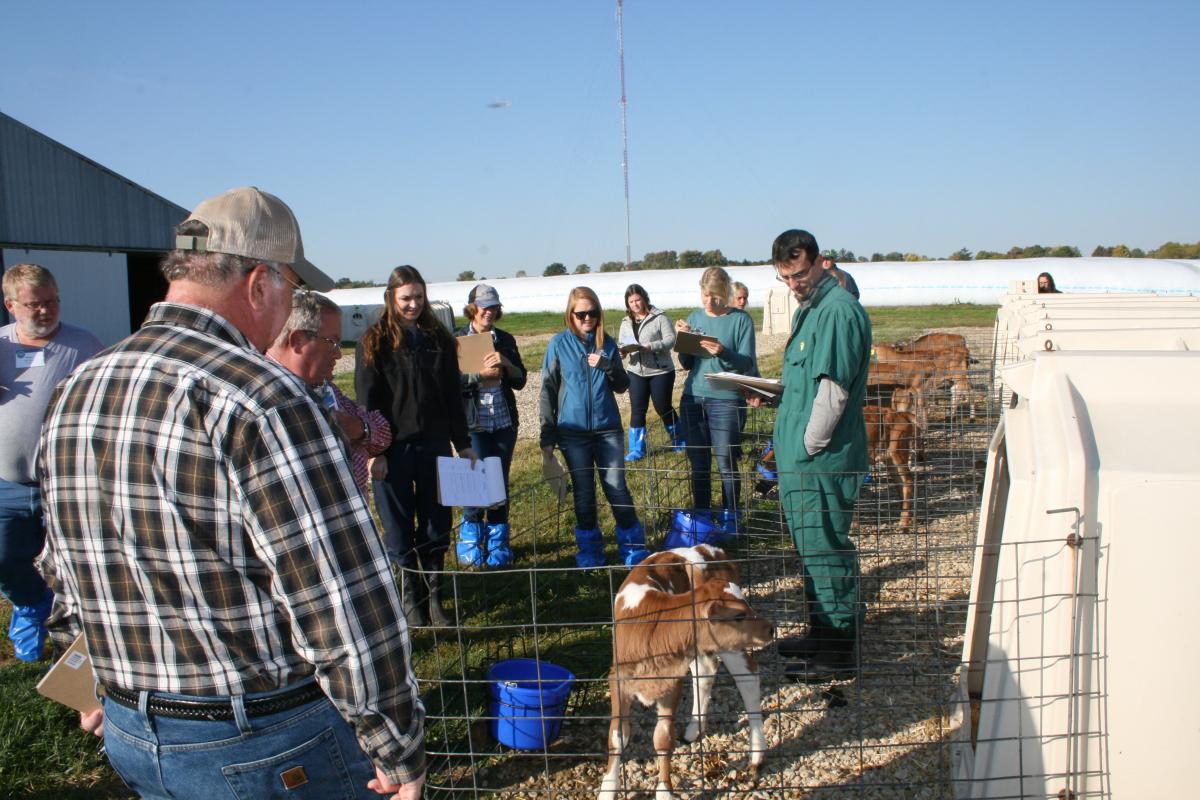
Also in preparation for FARM Animal Care Version 3.0, FARM staff hosted four regional Train-the-Trainer events. More than 100 trainers came to Ithaca, N.Y., Minneapolis, Minn., Columbus, Ohio, and Phoenix, Ariz., to participate in two days of intensive training provided by experts from Praedium in conjunction with the FARM Animal Care staff.

Materials and other information on FARM 3.0 are available on the FARM Program website. Additional materials related to animal care will be available in 2017.

FARM Stakeholder Engagement

For the first time, the FARM Program hosted a full day of programming at the annual meeting of the American Association of Bovine Practitioners (AABP) to further engage with the veterinary community.

Veterinarians have and will continue to play an integral role in ensuring excellent animal care on dairy farms. With a heightened focus on a Veterinarian-Client-Patient-Relationship and the Herd Health Plan in Version 3.0 of FARM Animal Care, the AABP meeting was an excellent venue to communicate the importance of veterinary involvement.

Additionally, FARM held its first-ever Evaluator Conference last month in Nashville, TN as a professional development and networking opportunity for nearly 70 FARM Program evaluators. Attendees participated in leadership development training, learned how to further help farmers embrace the FARM program, and heard about the latest research related to animal welfare and sustainability. Bringing together evaluators from all over the country allowed for shared conversations around successes, challenges and peer-to-peer learnings.

CWT-Assisted Export Sales Contracts Total 4.5 Million Pounds in November

Cooperatives Working Together assisted member cooperatives in securing 22 contracts to export 3.1 million pounds of American-type cheese and 1.4 million pounds of butter in the month of November. The products will go to customers in Asia, the Middle East, North Africa and Oceania. The product will be shipped from November 2016 through February 2017.

Year to date, CWT has assisted its members in winning export sales contracts totaling 47.3 million pounds of American-type cheese, 12.7 million pounds of butter (82% milkfat) and 21.3 million pounds of whole milk powder, destined for customers in 24 countries on five continents. These sales are the equivalent of 878.5 million pounds of milk on a milkfat basis. Totals are adjusted for cancellations received during the month.

Assisting CWT member cooperatives gain and maintain world market share through the Export Assistance program in the long-term expands the demand for U.S. dairy products and the U.S. farm milk that produces them. This increases demand which positively affects all U.S. dairy farmers by strengthening and maintaining the value of dairy products that directly impact their milk price.

The amounts of dairy products and related milk volumes reflect current contracts for delivery, not completed export volumes. CWT will pay export assistance to the bidders only when export and delivery of the product is verified by the submission of the required documentation.

All cooperatives and dairy farmers are encouraged to add their support to this important program. Membership forms are available online.

NMPF Urges Participation in Upcoming USDA Dairy Cost of Production Survey

The U.S. Department of Agriculture’s National Agricultural Statistics Service (NASS) is in the process of conducting its Agricultural Resource Management Survey (ARMS) for dairy farms, also known as the Dairy Cost of Production Survey. NMPF makes extensive use of this information and strongly encourages dairy producers to participate if called upon to do so. Specifically, NMPF will be using USDA cost of production data as it works with the new Congress to make improvements in the Margin Protection Program.
The ARMS survey provides updated information about the financial well-being, costs of production and production practices of the U.S. dairy sector. In addition to providing solid data for USDA research on dairy production, the ARMS survey information is used to build accurate baseline information for the USDA monthly and annual reports on the cost of milk production. The ARMS surveys examine selected commodities on a rotating basis. This year, it is collecting data for corn and milk production, including the organic dairy sector. Dairy production is surveyed every five years.

Last summer, USDA screened and selected a sample of 3,269 dairy producers in 28 states for the survey. The survey will be administered by trained field enumerators who will schedule appointments from December 2016 through April 2017 with the individual dairy operators in the sample. The higher the participation in this year’s dairy ARMS survey, the better the quality of the information available to the industry. If you have any questions about participating, please contact Peter Vitaliano.

MPP Forecast: December

USDA’s National Agricultural Statistics Service (NASS) last week reported the October U.S. average all-milk price at $16.60 per hundredweight., down 70 cents from September’s price. The drop in October was closely related to changes in federal order class prices from September to October, when the Class III price fell by $1.57 per hundredweight, the Class IV price was down by $0.59 per hundredweight., and the Class I mover nudged ahead just 4 cents.

USDA’s Agricultural Marketing Service (AMS) last week also announced the November class and component prices. From October to November, the Class III price rebounded by $1.94 per hundredweight, the Class I mover dropped by $1.82 per hundredweight (mirroring the drop a month earlier in the Class III price), and the Class IV moved ahead by 10 cents. The combined result of these announced price changes is likely to be that the November all-milk price will bounce back to its September level ($17.30 per hundredweight) when it is announced at the end of this month.

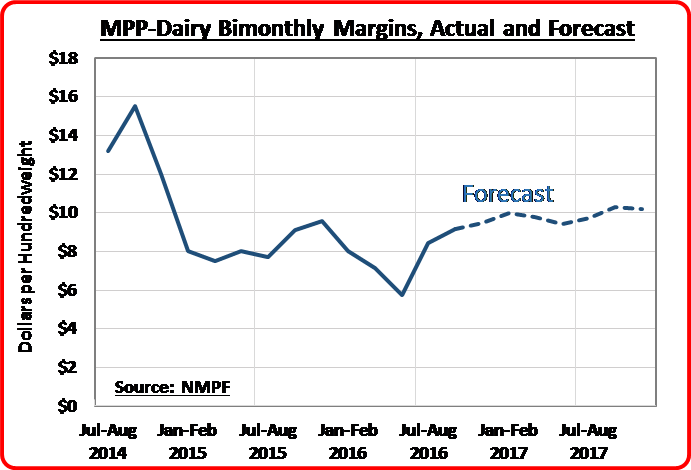
USDA-NASS last week also reported feed prices for October. The NASS price announcements will result in a September-October MPP margin of $9.165 per hundredweight. USDA’s current forecast (at right), based on the December 1 CME futures settlements, projects that the MPP margin will remain above $10.00 per hundredweight through 2017. USDA’s MPP margin forecasts are updated daily online.

Dairy farmers have from now until Dec. 16 to enroll in the Margin Protection Program for coverage in 2017, or to change their coverage level if they are already participating in MPP. NMPF’s Future for Dairy website offers a variety of educational resources to help farmers select the desired coverage level.

Dairy Groups Send Letter to President-Elect Trump Seeking Dialogue on Dairy Trade

With President-elect Trump and a new Congress about to take office next month, NMPF is seeking a dialogue with incoming officials on several issues critical to the health of America’s dairy farms. This list includes leading a discussion about how U.S. dairy exports help the economy and benefit from an effective trade policy, as the National Milk Producers Federation and the U.S. Dairy Export Council (USDEC) explained in a letter sent Tuesday to President-elect Donald Trump.

In the groups’ letter to the President-elect, NMPF President and CEO Jim Mulhern, and USDEC President Tom Suber, highlighted the positive impact that prior trade agreements’ agricultural provisions have had on the dairy industry and, further, on employment in rural America. To maintain these benefits, the letter said, it is important to preserve current overseas dairy sales while seeking to achieve new gains by removing foreign barriers that currently hold back additional exports.

The USDA estimates that at the dairy farm level, each $1 billion of U.S. dairy exports generates more than 20,000 jobs and almost $3 billion of economic output. At the manufacturing level, USDA calculates that U.S. dairy exports support approximately 3,200 jobs per $1 billion of exports. Currently, the U.S. exports the milk produced on American farms one day of each week.

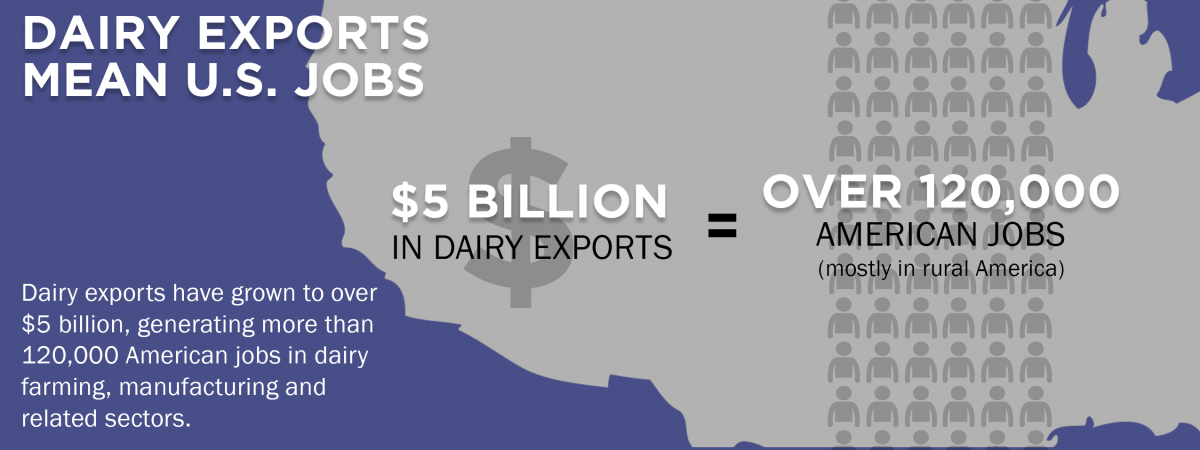
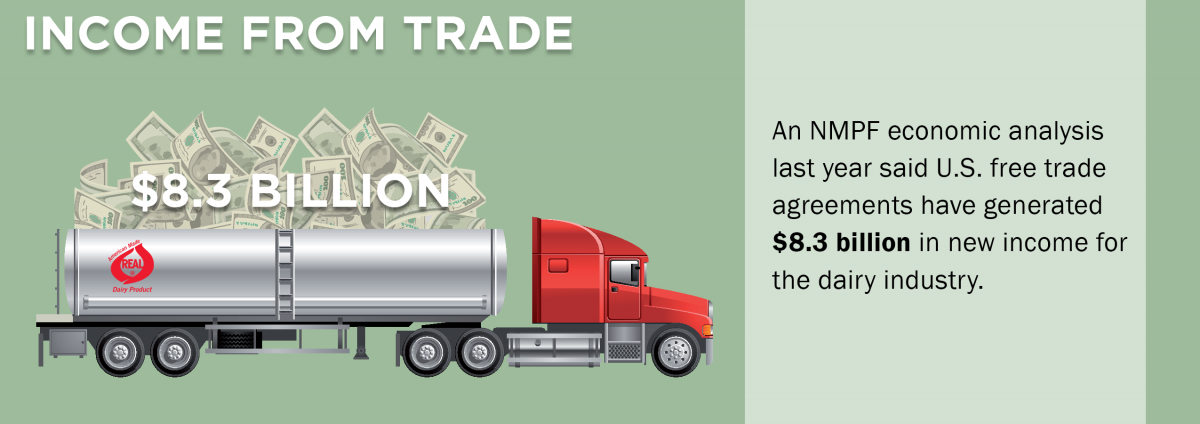
“During the last two decades, dairy exports have grown from less than a billion dollars a year to over $5 billion last year, in the process generating more than 120,000 jobs in dairy farming, manufacturing and related sectors,” the letter said. A 2015 NMPF economic analysis calculated that U.S. free trade agreements’ (FTAs) dairy provisions have played a key role in that growth, generating an additional $8.3 billion for the industry between 2004-2014.

To maintain and grow those sales, U.S. dairy farmers and processors need a level international playing field to compete, the letter to Trump noted. Additionally, NMPF and USDEC noted their agreement with President-elect Trump that current trade agreements must be strictly enforced. Protectionist policies that run contrary to established agreements, such as the Canadian dairy pricing schemes and the European abuse of geographical indications, must be immediately addressed and reversed. NMPF and USDEC also listed other key factors to help preserve overseas dairy sales, including a focus on how U.S. regulatory agencies should do more to resolve technical trade barriers to exports.

“We want to work with you to grow the rural economy and increase American jobs for dairy farmers and processors,” the letter concluded, “by tackling the various international trade challenges facing them.”

Dairy Groups Send Letter to President-Elect Donald Trump Detailing Importance of Dairy Trade

ARLINGTON, VA – The National Milk Producers Federation (NMPF) and the U.S. Dairy Export Council (USDEC) sent a joint letter today to President-elect Donald Trump outlining the importance of exports to the U.S. dairy sector and seeking further dialogue on ways the organizations can work with the incoming administration on trade policy.
NMPF and USDEC said in their letter that expanded agricultural trade has created thousands of jobs and billions of dollars in economic activity in rural America. The two organizations said it is important “to preserve current overseas dairy sales while seeking to achieve new gains by removing foreign barriers that hold back additional exports,” according to NMPF President and CEO Jim Mulhern.

The USDA estimates that at the dairy farm level, each $1 billion of U.S. dairy exports generates more than 20,000 jobs and almost $3 billion of economic output. At the manufacturing level, USDA calculates that U.S. dairy exports support approximately 3,200 jobs per $1 billion of exports. Exports consume approximately 14% of the milk produced on American farms, the equivalent of one day’s production each week.

“During the last two decades, dairy exports have grown from less than a billion dollars a year to over $5 billion last year, in the process generating more than 120,000 jobs in dairy farming, manufacturing and related sectors,” said USDEC President Tom Suber.

He said that despite achievements made by free trade agreements, “rampant foreign nontariff barriers require a ramp-up in trade enforcement,” and urged the Trump Administration to closely monitor other nations’ compliance with existing market access concessions.

Emphasizing the need to ensure a level international playing field, Mulhern said that competitors to the U.S. dairy sector in Europe and Oceania “have not been happy to see the U.S. seizing market share from them in the last 15 years. They would relish the opportunity to regain an advantage over U.S. suppliers.”

###

The U.S. Dairy Export Council (USDEC) is a non-profit, independent membership organization that represents the global trade interests of U.S. dairy producers, proprietary processors and cooperatives, ingredient suppliers and export traders. Its mission is to enhance U.S. global competitiveness and assist the U.S. industry to increase its global dairy ingredient sales and exports of U.S. dairy products. USDEC accomplishes this through programs in market development that build global demand for U.S. dairy products, resolve market access barriers and advance industry trade policy goals. USDEC is supported by staff across the United States and overseas in Mexico, South America, Asia, Middle East and Europe.

The National Milk Producers Federation (NMPF), based in Arlington, Va., develops and carries out policies that advance the well-being of U.S. dairy producers and the cooperatives they collectively own. The members of NMPF’s cooperatives produce the majority of the U.S, milk supply, making NMPF the voice of dairy producers on Capitol Hill and with government agencies. For more on NMPF’s activities, visit www.nmpf.org.

Elections Have Consequences

The election last month of Donald Trump as the 45th U.S. president surprised most political watchers, who gave him low odds of winning. But examined in the light of the eight-year cycle of alternating presidential leadership between the two parties dating back 35 years (with the 1988 election of George Bush being the lone exception), it’s less surprising that President-elect Trump was this election’s opportunity for voters to make yet another change.

The transition process will produce some surprises as we move toward January, but it’s already clear that the Trump Administration will usher in a new approach in Washington to some of the issues of interest to dairy farmers.  In every respect, this is an opportunity for dairy farmers both to seek new paths to achieve our goals, and also to accelerate ongoing efforts to make needed changes.  Let me briefly highlight some front-burner issues for National Milk on which we hope to make more progress in 2017.

One of the key priorities we discussed at the recent NMPF annual meeting in Nashville is to strengthen the safety net for dairy farmers.  Our members are working to identify changes that will make the Margin Protection Program more reliable and effective. We are also discussing with key Congressional leaders our desire to adopt changes in the near term, instead of waiting for the current farm bill to expire at the end of 2018. Rural areas delivered many votes for the new president, and it’s clear that a sense of economic unease and uncertainty was a driver of that voter turnout.  Fixing the dairy margin program in order to help farmers better deal with volatility must be a priority for our industry, Congress and the new USDA.

No issue on the campaign trail this year was as hotly-contested as immigration.  We are now reaching out to the Trump team to discuss dairy’s unique labor challenges. Specifically, dairy farm employers need the certainty of access to their current workforce, as well as to a future supply of farm workers on a year-round basis.  Farm and ranch groups have collaborated in the recent past on a new visa program that could provide a legal source of foreign-born workers to those in agriculture.  Rural America can’t grow without a stable workforce. That is a message we will continue to deliver in the coming months so that our farms have access to the workers they need so agriculture can continue its contributions to our economy.

Trade policy is another issue that drew a spotlight in the campaign, and will continue to evolve under the new administration.  While momentum behind the Trans-Pacific Partnership and the TransAtlantic Trade and Investment Partnership has stalled for the time being, the need for U.S. dairy access to foreign markets has not.  NMPF will continue to highlight how dairy exports are economically important to farmers and dairy processors, as well as to thousands of other workers in rural America whose jobs depend on a healthy and growing U.S. agriculture.  

Another expected early focus of the new administration is tax policy reform. Cuts in the rates paid by individuals and corporations will be sought and a paring down or eliminating the estate tax also will be under consideration.  One of NMPF’s tax priorities is for Congress to adopt the nutrient recovery and biogas tax credit measure that we worked with a bipartisan group of legislators in both the House and Senate to introduce earlier this year. All of these issues will be part of our focus.

An issue on the environmental side is the problematic Waters of the U.S. (WOTUS) regulation, which the Environmental Protection Agency and the Army Corps of Engineers tried implementing despite the rule’s many flaws.  The regulation is currently being stayed by a federal appeals court ruling, and it seems very likely that it will be one of the first major regulations to get the boot from the new administration.

In the area of nutrition, NMPF will continue its efforts to reform the school lunch program so that federal regulations once again make 1% flavored milk an offering in the lunch line.  If Congress fails to address the issue during its short end-of-year lame duck session in December, NMPF, working in concert with IDFA, will press incoming members of the new Congress and the new staff at USDA on the importance of changing the short-sighted school lunch policy that has led to a decline in consumption of milk in schools.

All transitions of power in Washington produce their own surprises and unexpected developments; the arrival of the Trump Administration will be no exception.  What won’t change is NMPF’s ongoing focus on finding new opportunities to advance the policy interests of dairy farmers in the coming years.

FARM Program Version 3.0 Online Evaluator Training Available

The FARM Animal Care Program Version 3.0 online evaluator training is now available for any individual who would like to certify or re-certify to perform Version 3.0 Animal Care evaluations.

The program can be accessed at www.aglearning.com by clicking on the green tab at the top of the page labeled Public Course Offerings. Next, scroll down the page to the course labeled Second-Party Evaluator, submit a payment, and the training will then begin. After the course concludes, evaluators must take the exam and pass with at least an 80% score to be considered a Version 3.0 FARM Animal Care evaluator.

First FARM Evaluator Conference Draws Robust Attendance

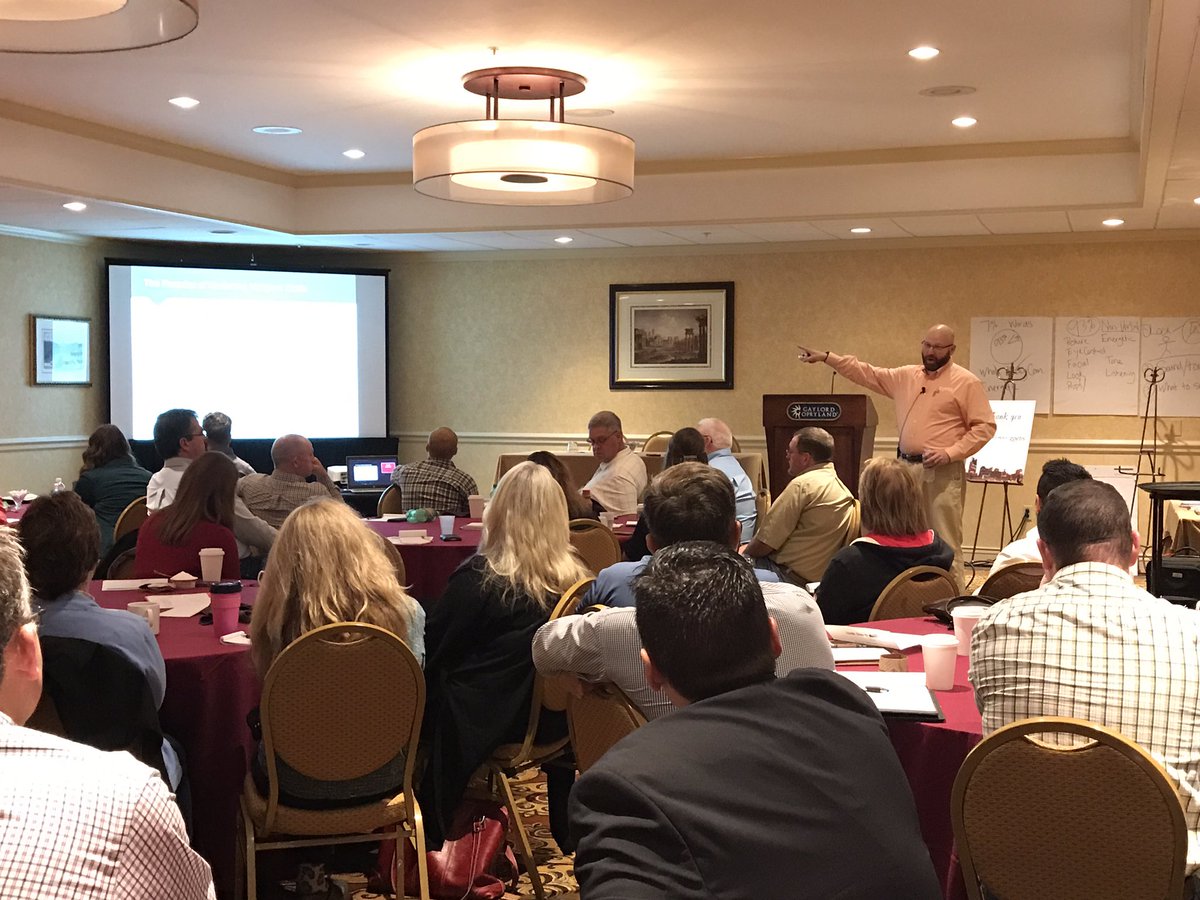
The first annual FARM Program Evaluator Conference, held after NMPF’s annual meeting earlier this month, drew strong turnout from more than 60 evaluators representing the majority of companies participating in the National Dairy FARM Program.

The event, held November 2-3 in Nashville, was sponsored by Elanco, Merck Animal Health and Zoetis. The keynote presentation was delivered by Amanda Kent, an expert in “Life Hacks,” who shared insights into how those in the audience can reach their leadership potential, especially when sharing the FARM Program message with all industry stakeholders.

Following the keynote address, two panels consisting of current FARM Program evaluators and members of the Technical Writing Group shared their insights on how to assist farms through upcoming changes, such as the elimination of tail docking and the expanded role of veterinarians in the program. The first day concluded with communications consultant David Pelzer outlining how FARM plays a critical role in crisis management in the dairy community.

The second day of the conference focused on the future of the FARM Program. Dr. Michael Lormore with Zoetis presented on the necessity of continued judicious antibiotic stewardship within the industry. Dr. Cassandra Tucker and Dr. Nina Von Keyserlingk also provided insight on the latest animal welfare and consumer-focused research. Each of these presentations generated ideas within the evaluator attendees that were shared in a group discussion about how the FARM Program can continually improve and evolve.

At the conclusion of the conference, a group of attendees also took advantage of a Stockmanship Training workshop offered by the Beef Quality Assurance Program at Middle Tennessee State’s Research and Education Center. Flight zones, points of balance and the importance of calm animal handling were reinforced throughout the training, and gave attendees a variety of resources that can be shared with their producer members.